Quick summary
The Costa Blanca North is the epicentre of bioclimatic pergola demand in the Alicante province. The combination of high-end tourism, restaurant terraces overlooking the Mediterranean, and a community of residents who value outdoor living makes Benidorm, Altea, Calpe, Dénia and Jávea the municipalities with the highest pergola density per resident in the entire Valencia region. A 4 × 3 m bioclimatic pergola installed with materials adapted to the coastal climate costs between €5,500 and €13,000 in 2026, and its useful life exceeds 25 years with proper maintenance.
This guide analyses why bioclimatic pergolas dominate in this area, which materials withstand the coastal climate, the differences between residential and hospitality installations, local regulations, and current pricing.
Why is the Costa Blanca North pergola territory?
The Costa Blanca North, from Benidorm up to Dénia, has characteristics that make the bioclimatic pergola the dominant sun-protection solution over alternatives like awnings or shade sails.
A climate that invites outdoor living
With over 300 days of sun a year, average temperatures of 18°C in winter and 28°C in summer, and a fair-weather season running from March to November, terraces on the Costa Blanca North get used almost year-round. A simple awning that provides summer shade isn’t enough: residents and businesses need a solution that protects from sun, occasional rain, and wind, without sacrificing light and ventilation. Exactly what a bioclimatic pergola with adjustable louvres delivers.
A demanding hospitality sector
Benidorm, with over 130 hotels and hundreds of restaurants, is one of Spain’s most important tourist destinations. Altea, Calpe, Dénia and Jávea complement the offering with high-quality gastronomy that draws both tourists and locals. For these businesses, the terrace is the main commercial asset: a covered terrace with a pergola can operate 11 months a year, while an open terrace is only profitable for 6-7 months.
Bioclimatic pergolas allow restaurants and hotels to:
- Extend the terrace season from April-October to February-November
- Protect customers from rain without closing the terrace
- Regulate light to create different atmospheres (bright lunch, intimate dinner)
- Integrate LED lighting, heaters and windbreaks for maximum comfort
- Comply with municipal hospitality terrace regulations
A high-value residential market
The Costa Blanca North is home to a mid-to-high-end and luxury property market, with front-line villas in Altea, Jávea and Dénia frequently exceeding €1 million. In these homes, a bioclimatic pergola doesn’t just provide sun protection: it adds tangible property value, estimated at 5-10% of the terrace or outdoor-zone value.
Costa Blanca North winds: what you need to know
Choosing a pergola on the Costa Blanca North can’t ignore the specific wind patterns of this area. They differ from those in the Vega Baja or Alicante city, and they directly affect design and installation.
Tramontana
A north-northwesterly wind, cold and dry, that especially affects Dénia, Jávea and northern Calpe due to their direct exposure to the Cap de la Nau corridor. Gusts can reach 60-80 km/h and persist for 2-3 days. It is most frequent between November and March.
Impact on pergolas: a quality bioclimatic pergola handles these winds without issue (the best are certified up to 120 km/h), but it’s essential that louvre orientation accounts for the prevailing wind direction to prevent pressure build-up under the structure. For north-facing installations in Jávea or Dénia, we recommend complementing the pergola with side windbreaks.
Levante
An easterly wind, humid and sometimes strong, affecting the entire coast. Brings rain and ocean swell. Gusts can reach 50-70 km/h during autumn storms (cold-drop or DANA events). Benidorm and Calpe, due to their coastal orientation, are particularly exposed.
Impact on pergolas: the Levante is the main reason pergola rainwater drainage must be generously sized. In Benidorm and Calpe we recommend 60 mm downpipes (rather than the standard 40 mm) to handle torrential rain of up to 100 l/m² in just a few hours.
Sea breeze
The daytime thermal breeze (10-20 km/h) is constant from May to September across the entire Costa Blanca North. It’s pleasant and poses no risk to structures, but it deposits salt on surfaces continuously.
Impact on pergolas: this constant salt exposure makes marine treatment of the aluminium lacquer essential.
Anti-corrosion treatment for aluminium structures
Aluminium is the standard material for bioclimatic pergolas, and rightly so: it’s light, strong, doesn’t rust in the traditional sense, and supports elegant finishes. However, in a marine environment like the Costa Blanca North, aluminium without proper protection suffers pitting corrosion, which appears as small white or grey spots on the surface and can degrade the look within 3-5 years.
Lacquer protection levels
| Protection level | Treatment | Estimated useful life (coast) | Relative price | Recommended for |
|---|---|---|---|---|
| Standard | Powder coating 60 microns | 8-12 years | Base | Inland, more than 5 km from coast |
| Marine | Powder coating 80-100 microns + epoxy primer | 15-20 years | +15-20% | Coast, up to 500 m from sea |
| Marine reinforced | Powder coating 100+ microns + pre-anodising + epoxy primer | 25-30+ years | +25-35% | Front-line coast, terraces over the sea |
Our recommendation for the Costa Blanca North: marine treatment as a minimum. For front-line installations (hotels on Benidorm’s seafront promenade, restaurants in Altea’s port, villas with direct sea access in Jávea), reinforced marine treatment is the smartest investment.
Fasteners and hardware
- Fasteners: AISI 316 stainless steel without exception across the entire Costa Blanca North. Even in Altea or Calpe old town, a few hundred metres from the sea, salt air arrives easily.
- Floor anchors: stainless-steel plates or hot-dip galvanised steel with epoxy coating.
- Motors and electronics: confirm IP65 or higher rating to resist humidity and salt air.
Residential vs. hospitality installations
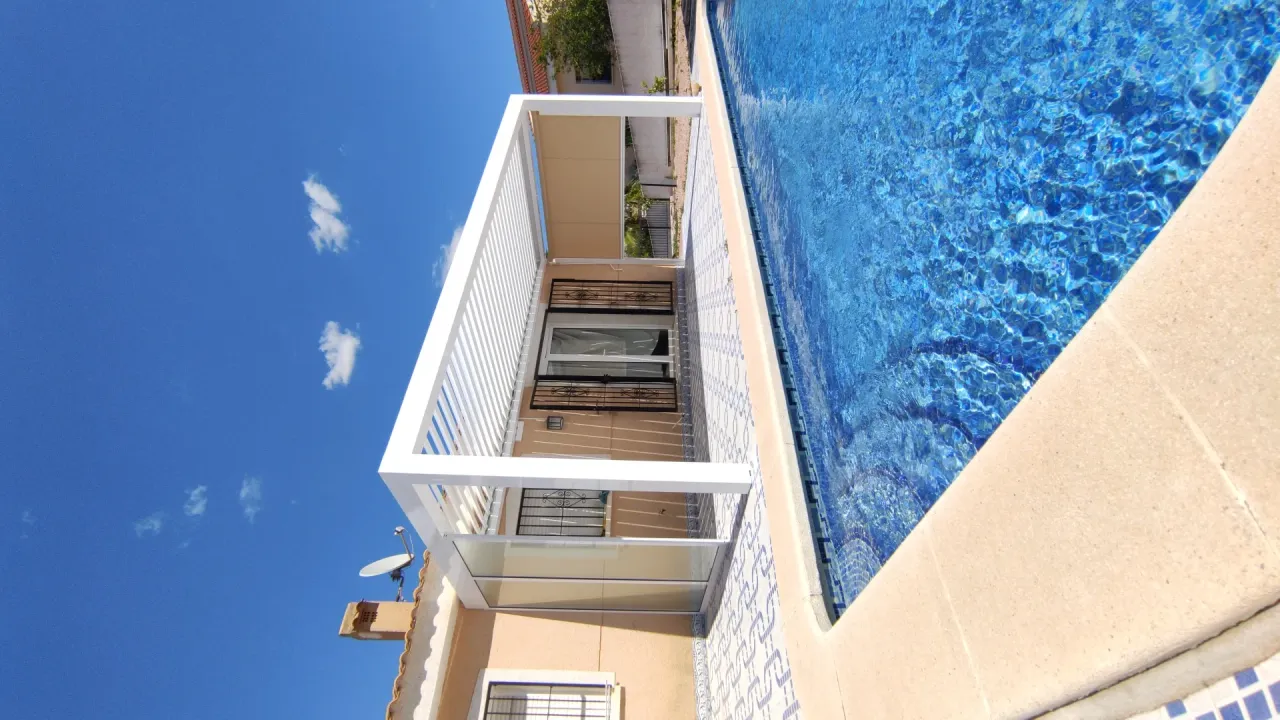
Pergolas for private homes
The typical residential installation on the Costa Blanca North covers a terrace of 12-30 m² attached to the home. The most-requested features are:
- Motorised adjustable louvres with remote control and smart-home integration (Somfy, Google Home, Alexa)
- Integrated LED lighting in the beams for night-time use
- Lacquer colour: anthracite (RAL 7016) and quartz grey (RAL 7039) are the most requested, followed by white (RAL 9010) for Mediterranean-style homes
- Side windbreaks on at least one side (typically the side exposed to Tramontana or Levante), either with a vertical screen awning or with glass curtains for a more complete enclosure
- Hidden water drainage through the pillars, connected to the terrace drain
Average size: 4 × 3.5 m to 6 × 4 m (14-24 m²)
Average installed price: €6,000-15,000 depending on size and finishes
For more on the differences between pergola and awning in residential settings, see our detailed comparison.
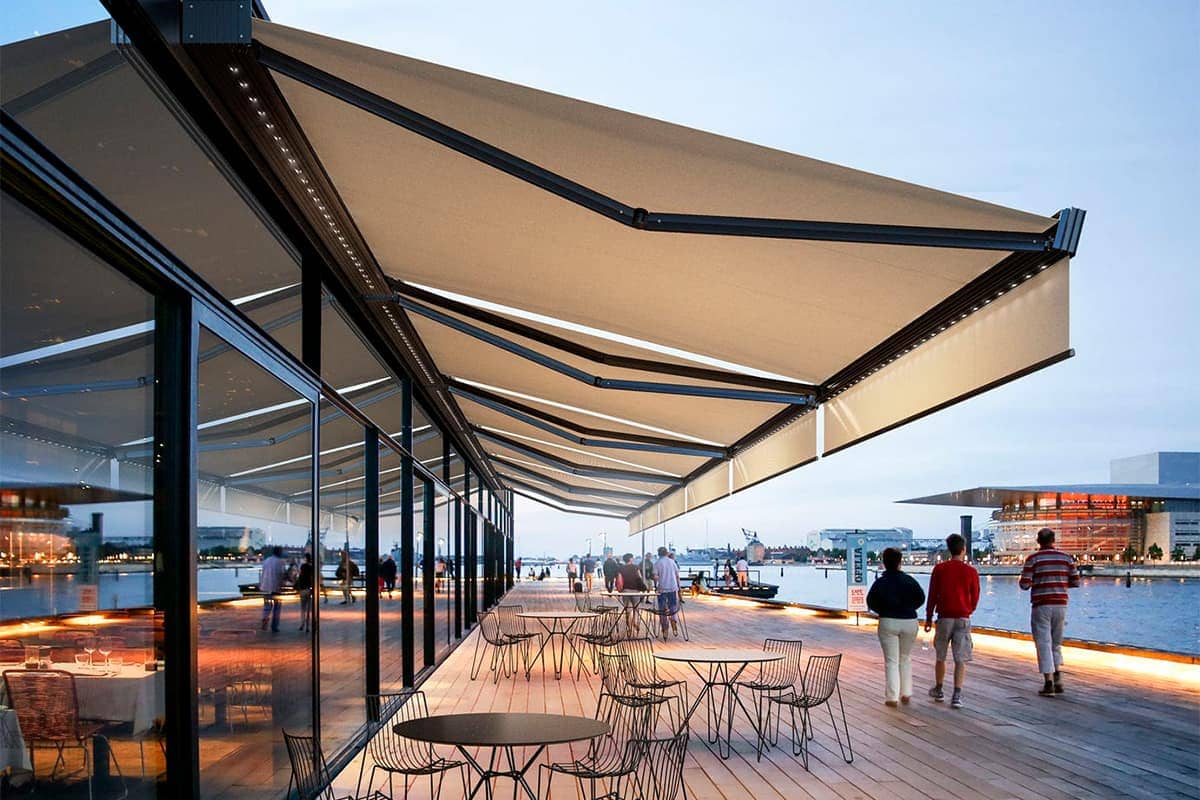
Pergolas for hospitality (restaurants, hotels, beach bars)
Hospitality installations have additional requirements that increase both complexity and budget:
- Larger dimensions: it’s common to cover surfaces of 40-100 m² with connected modules. Bioclimatic pergolas can be joined in multi-module configurations sharing intermediate pillars.
- Reinforced structural strength: hospitality terraces typically face higher wind loads due to their location (seafront promenades, ports) and must meet stricter regulations.
- Professional lighting: dimmable LED systems with intensity and colour-temperature control to create different atmospheres.
- Integrated infrared heaters: enable winter terrace use (November-February) with temperatures of 10-15°C.
- Side windbreaks and enclosures: combination of vertical screen awnings and glass curtains to fully enclose the terrace during storms without losing views.
- Signage and branding: option to integrate logos in beams or custom lighting.
Average size: 30-80 m² (modular configurations)
Average installed price: €15,000-60,000 depending on surface area and equipment
Hospitality ROI: a 50 m² covered terrace at a Benidorm or Altea restaurant can generate €150-400 in additional daily revenue during the months it previously couldn’t be used (November-March). With 100-120 additional days of use per year, the return on a €30,000 investment is typically achieved in 1-2 seasons.
Local regulations: what you need to know in each municipality
Each Costa Blanca North municipality has its own urban planning rules. This is what we’ve found relevant for pergola installation:
Benidorm
Benidorm has specific regulations for hospitality terraces that directly affect pergolas:
- Hospitality terraces: require public-space occupation licence and, for fixed structures like pergolas, a minor planning licence or “declaración responsable” (responsible declaration) depending on the case.
- Maximum height: pergolas cannot exceed the level of the building’s first-floor slab.
- Setback: structures on terraces facing public roads must respect a minimum setback that varies by zone (check with the planning department).
- Private homes: for removable pergolas on private terraces, a “declaración responsable” is generally enough. If it involves civil works (footings, foundations), a minor works licence is needed.
- Communities of owners: 3/5 majority approval at the owners’ meeting if the structure alters the appearance of the façade or roof.
Altea
Altea is especially strict in its old town, designated as Bien de Interés Cultural (a heritage-protected site):
- Old town: any installation visible from the public street requires a favourable report from the regional Culture department. Only materials and colours respecting traditional aesthetics are permitted (predominantly white, natural wood). Dark aluminium pergolas (anthracite, black) are generally prohibited in the old town.
- Rest of the municipality: “declaración responsable” for removable pergolas; minor works licence for foundation-anchored structures.
- Hospitality in the port: specific Port d’Altea regulations may impose additional design and colour requirements.
Calpe
- Peñón de Ifach area: landscape restrictions due to proximity to the Natural Park. Pergolas must integrate visually with the surroundings.
- Hospitality terraces: public-space occupation licence. Pergolas in port restaurants need approval from the Port Authority in addition to the council.
- Private homes: “declaración responsable” for most installations.
Dénia
- Historic centre and Castle area: heritage restrictions similar to Altea. A Heritage department report is required.
- Las Marinas and Les Deveses zones: standard urban planning regulation. “Declaración responsable” sufficient for pergolas on private homes.
- Commercial and recreational port: specific port regulations for hospitality terraces.
Jávea (Xàbia)
- Old town (pueblo): moderate aesthetic restrictions. Natural materials and light colours are favoured.
- Arenal zone: standard regulation with “declaración responsable”.
- La Granadella and Portitxol zones: landscape restrictions due to natural-heritage value. Check with the council case by case.
General tip: in every municipality, we recommend starting a preliminary consultation with the planning department before formalising the order. At Optim Toldos we prepare the necessary technical documentation (plans, material data sheets, simulations) as part of our service. See our full planning permission guide for pergolas and awnings for the seven main councils.
Recommended materials for the Costa Blanca North
Based on our installation experience in the area, these are the specifications we recommend:
Structure
- Material: extruded aluminium alloy 6063-T5
- Lacquer: marine treatment (minimum 80 microns) with epoxy primer. On the front-line coast, reinforced marine treatment (100+ microns with pre-anodising)
- Most-requested colours: anthracite RAL 7016 (42% of our installations), white RAL 9010 (28%), quartz grey RAL 7039 (18%), wood-effect (12%)
Louvres
- Material: extruded aluminium with EPDM sealing strips
- Orientation: 0° to 135° motorised
- Water drainage: integrated channelling system in the louvres with discharge through the pillars
Motorisation
- Motor: tubular with obstacle detection, IP65 rating minimum
- Control: radio-frequency remote + smart-home integration option (Somfy TaHoma, Google Home, Alexa)
- Recommended sensors: wind sensor (essential), rain sensor (closes louvres automatically), sun sensor (optional)
Most-installed accessories
- Perimeter LED lighting: integrated in the beams. Dimmable. Cost: €300-800 depending on size.
- Vertical screen awning windbreaks: closes one side with microperforated fabric that blocks wind without blocking views. Cost: €500-1,500 per side.
- Glass curtains: complete enclosure of one or more sides with folding tempered-glass panels. See our glass curtains terrace enclosure guide for prices and details.
- Infrared heaters: integrated in the beams for winter use. Cost: €400-1,200 per module.
Bioclimatic pergola prices on the Costa Blanca North (2026)
Prices include aluminium structure with marine treatment, motorised adjustable louvres, remote control, water drainage, and professional installation:
| Size | Mid-range | Premium | With extras (LED + 1 windbreak) |
|---|---|---|---|
| 3 × 3 m (9 m²) | €4,500-6,500 | €7,000-10,000 | €6,000-12,000 |
| 4 × 3 m (12 m²) | €5,500-8,000 | €8,500-13,000 | €7,500-15,500 |
| 5 × 4 m (20 m²) | €8,000-12,000 | €12,000-18,000 | €10,500-21,000 |
| 6 × 4 m (24 m²) | €10,000-15,000 | €15,000-22,000 | €13,000-25,500 |
| Hospitality module (6 × 5 m) | €14,000-20,000 | €20,000-30,000 | €18,000-38,000 |
Note: front-line coast installations with reinforced marine treatment can increase the budget by 15-25%. Modular hospitality configurations (multiple connected modules) benefit from economies of scale above 40 m².
For a direct comparison between pergola and awning (including annualised cost analysis), see our comparison guide.
Installation process: what to expect
For private homes
- Free technical visit (1-2 hours): space measurement, anchor assessment, solar orientation, wind exposure, and discussion of aesthetic preferences.
- Detailed quote (delivered in 48-72 hours): includes plans, material selection, visual simulation, and price breakdown.
- Permit handling (if needed): preparing documentation for the community of owners or municipal “declaración responsable”.
- Manufacturing (3-5 weeks from order confirmation): pergolas are made to measure.
- Installation (1-3 days): structure assembly, motor installation, sensor programming, and function tests.
- Final review and handover with usage and maintenance manual.
For hospitality
The process is similar but includes additional phases:
- Technical project with detailed plans (may be required if the council demands it for the licence)
- Coordination with business operations to minimise closure days
- Phased installation for multi-module configurations
- Staff training on system use and maintenance
Maintenance on the Costa Blanca North
Maintenance of a bioclimatic pergola on the Costa Blanca North is simple but not optional. The marine environment shortens cleaning intervals compared to inland installations.
Recommended maintenance routine
| Task | Frequency (coast) | Frequency (inland) | Time |
|---|---|---|---|
| Louvre cleaning with hose | Monthly | Every 2-3 months | 15 min |
| Water-channel cleaning | Quarterly | Twice a year | 20 min |
| Mechanism greasing with silicone | Annual | Annual | 15 min |
| Fastener and seal inspection | Annual | Every 2 years | 30 min |
| Professional service review | Every 2-3 years | Every 3-5 years | 1 hour (~€100) |
After “calima” episodes
Saharan dust adheres firmly to aluminium and EPDM seals. Clean louvres and structure as soon as possible with medium-pressure water and, if needed, mild neutral soap. Never use abrasive products or metal scourers.
After Levante storms
After heavy rain, check that the water channel drains correctly and that no debris has accumulated in the seals. Confirm the rain sensor works (louvres should close automatically when water is detected) and that pillar drains are not blocked.
Frequently asked questions
Do I need a building licence to install a pergola at my villa in Benidorm?
For a removable pergola (no permanent foundation), a “declaración responsable” is generally enough. If concrete footings or civil works are required, a minor works licence is needed. Check with your council’s planning department.
Can I install a bioclimatic pergola on a penthouse in Calpe?
Yes, but a penthouse terrace is generally a common element of the building, which requires owners’ meeting approval. The pergola should be designed as a removable structure to ease approval. You’ll also need to confirm that the floor slab supports the structural load (rarely an issue, since an aluminium pergola weighs 25-40 kg/m²).
How long does the full installation take from first contact?
From the initial visit to finished installation, the typical timeline is 5-8 weeks. If municipal permits or community approval are needed, it can extend to 10-12 weeks.
Do bioclimatic pergolas withstand the Tramontana in Dénia?
Yes. Quality bioclimatic pergolas are certified to withstand winds of up to 120 km/h with louvres open. The Tramontana in Dénia rarely exceeds 80 km/h. That said, for very exposed installations (front-line in Les Rotes or La Granadella), we recommend adding side windbreaks.
What warranty do the pergolas come with?
The pergolas we install include: 10-year warranty on the aluminium structure, 5 years on motor and mechanisms, 2 years on electronic accessories (sensors, LED lighting). The warranty covers manufacturing and lacquer defects, provided the recommended maintenance plan is followed.
Request your quote for the Costa Blanca North
Whether you’re looking for a pergola for your home terrace in Jávea or need to cover the terrace of your restaurant in Benidorm, the first step is a technical visit where we assess the space, the wind and marine-exposure conditions, and your specific needs.
At Optim Toldos we cover the entire Costa Blanca North: Benidorm, Altea, Calpe, Dénia, Jávea, El Albir, Alfaz del Pi, La Nucía, Polop, Finestrat, Villajoyosa, El Campello and every locality in the Marina Alta and Marina Baixa.
Request your free no-obligation quote - we respond within 24 hours and visit you within 48.