Cassette awning
The fabric fully retracts inside a closed aluminium cassette when not in use. Maximum protection against salt, UV and rain. Our default recommendation for any coastal installation. Fabric life: 10+ years with minimal maintenance.

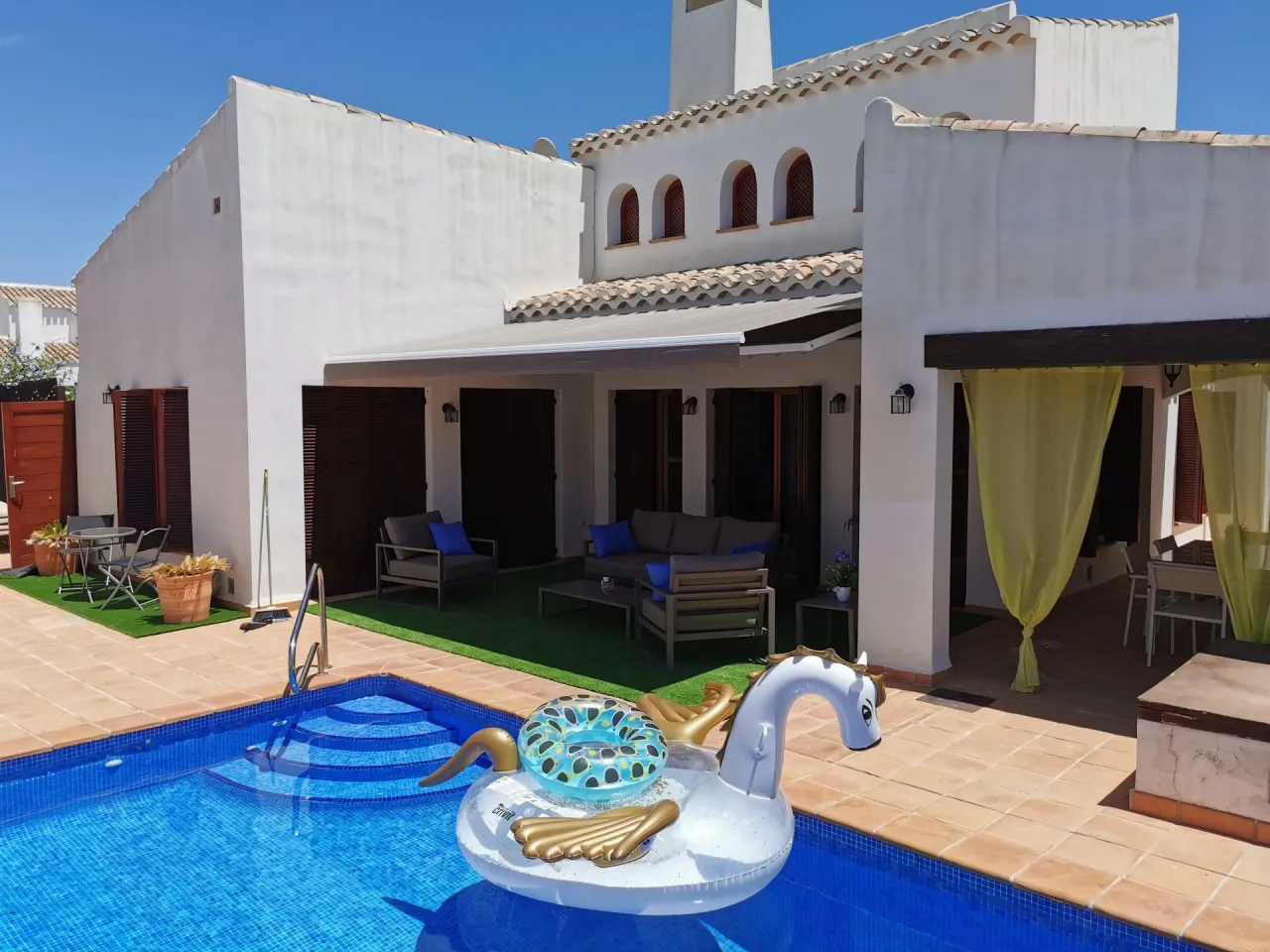
Practical guide specific to the Costa Blanca: orientation, levante wind, awning types and what each one costs.
Buying an awning seems simple until you sit in front of a sales rep and they show you six models, five motors, eight fabrics and a wind sensor you didn't know you needed. This guide is the map: which factors of your terrace determine the right awning type, when motorisation really matters, what difference a wind sensor makes, and what prices are reasonable in 2026 in the province of Alicante.
A south- or southwest-facing terrace takes direct sun for 6–8 hours in summer and needs opaque fabric with high UV protection. East- or west-facing orientations demand deeper awnings (1.5–2 m projection) because the sun arrives low. North-facing terraces barely need an awning except for rain.
If your terrace faces the sea or has an exposed facade, the levante wind is the critical factor. Rule out arm awnings without a cassette and prioritise closed-cassette models + an automatic wind sensor that retracts the awning when gusts hit 40+ km/h. In very windy spots, consider vertical screens instead of horizontal awnings.
For terraces or balconies up to 3 m wide, articulated-arm awnings are enough. Between 3 and 5 m, we recommend cassette. Above 5 m you need monobloc models, reinforced frame awnings, or split into two independent units to avoid stress on the arms.
In communities of owners, the statutes usually require colour and model uniformity. Check with the administrator before buying. In detached homes you have full freedom. In listed buildings or historic town centres (Elche PEPRI, Alicante centre) there are additional municipal aesthetic restrictions.
Three variables drive the technical spec for any awning in this area: (1) UV index 10–11 in July–August, which degrades untreated fabrics in 3–4 years; demands UV-treated fabrics with 30,000+ hrs Xenotest rating. (2) Salt air across the whole coastal strip up to ~5 km inland: demands anodised or high-durability powder-coated frames and stainless-steel fixings. (3) Poniente and levante gusts that can exceed 80 km/h several times a year: makes an automatic wind sensor essential on any motorised awning over 3 m wide.
The fabric fully retracts inside a closed aluminium cassette when not in use. Maximum protection against salt, UV and rain. Our default recommendation for any coastal installation. Fabric life: 10+ years with minimal maintenance.
More affordable version; the fabric stays exposed when retracted. Good option for wind-sheltered zones and terraces under a porch. Fabric life: 5–7 years on the coast.
Drops vertically to close off a side or front. Ideal for blocking low sun (east/west) or creating privacy in apartments. Combines with horizontal awnings or with a pergola. Motorised or hand-cranked.
Non-retractable fixed structure. Good solution for entrance doors, exposed windows or small porches where retraction adds no value. Low price, minimal maintenance.
Large format (5+ metres) with reinforced frame construction. Used in hospitality and wide terraces. Significantly higher price due to size and structure; suitable for restaurants and commercial terraces.
For any awning over 3 m wide, yes. The price difference between manual and motorised is usually €150–400 depending on brand. In return you gain: (1) real daily use - nobody cranks a handle every lunchtime - (2) automatic wind sensor that saves fabrics and arms in storms, (3) optional sun sensor that deploys the awning when you raise your blinds, (4) smart-home integration (Somfy, HomeKit). Very much worth it on the coast.
If you live in a community: (1) Ask your administrator for a copy of the uniformity agreement (model, colour, cassette type). (2) If no written agreement exists, check with the president before signing. (3) Take a photo of neighbours' awnings as a visual reference of the approved model. (4) Ask whether formal AGM authorisation is required (simple majority in most cases).
Fully installed, measured on-site, manufacturer-backed warranty. Ranges are indicative for the province of Alicante:
| Articulated-arm awning 3×2 m manual | €550 – €850 |
| Articulated-arm awning 3×2 m motorised | €850 – €1,300 |
| Cassette awning 4×3 m motorised + wind sensor | €1,600 – €2,400 |
| Cassette awning 5×3.5 m motorised + LED | €2,800 – €4,200 |
| Vertical screen motorised 3 m | €900 – €1,500 |
Quality UV-treated acrylic fabric stored in a cassette lasts 10 years or more. Permanently exposed (arm awning without cassette), fabric life drops to 5–7 years. Standard manufacturer warranty is 5 years.
For standard arm awnings, up to 5.5–6 m in a single unit. Above that we recommend splitting into two or using a reinforced monobloc for structural stability.
You'll need written consent from the owner and, if in a community, authorisation as required by the statutes. Some owners include the installation in the rent; others let you pay for it but the awning stays as a property improvement.
Acrylic fabrics are water-repellent - they shed light rain - but not 100% waterproof. For real protection against heavy rain you need technical waterproof fabric (PVC-coated polyester or PVC fabric) or a bioclimatic pergola.
Light colours reflect more light and keep the space below cooler, but show dirt more easily. Dark colours absorb more heat and may create a warmer zone. Earth tones (sand, terracotta) are the best aesthetic and functional compromise for the Mediterranean.
From quote signature: 2–4 weeks manufacturing (standard colours and sizes) up to 6–8 weeks for special fabrics or large-format cassettes. The install itself takes 2 to 6 hours depending on model.
Free on-site technical visit. We measure, show you real fabrics, and deliver a detailed quote within 24–48 hours.