
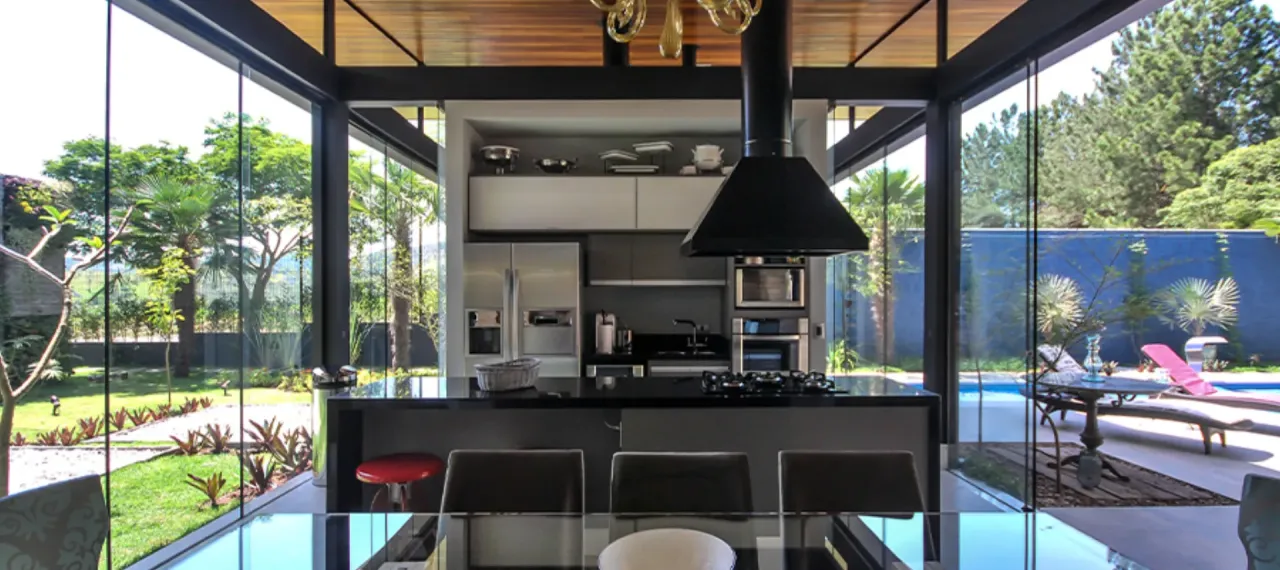
Complete guide to glass curtains
How they work, whether you need permission, what they cost, and when they are the right solution for your Costa Blanca terrace.
Frameless glass curtains have transformed Costa Blanca terraces. They lightly close off the levante wind, keep urban dust out, preserve sea views without vertical frame interruption, and make the terrace usable in winter with a 5–8 °C temperature lift over the outdoor air. This guide explains how they work, which regulations apply, and what they cost.
How they work: folding vs sliding
Folding system
Tempered glass panels (8 or 10 mm) slide sideways along a top rail and stack up together at one end (like an accordion), leaving the front completely open. Ideal when you want occasional full opening - summer, parties, cleaning - and a clean front enclosure the rest of the time.
Sliding system
Each panel has its own track and slides independently on top and bottom rails. Lets you open specific sections (e.g. the centre panel) without moving the others. More stable against wind and more common in large or high-rise installations.
What "frameless" means
Traditional glass curtains have aluminium frames between panels. The frameless ones we install at Optim Toldos only have top and bottom rails; the vertical edges of each panel are polished glass meeting the next panel directly, with optional translucent rubber seals. The visual difference is huge: your terrace looks unglazed, and the views stay intact.
Year-round use
Tempered glass with these seals isn't hermetic like a window, but on the Costa Blanca that's enough: it cuts wind from 100% exposure to light ventilation, and creates a moderate greenhouse effect that lifts inside temperature 5–8 °C in the sun. In summer you open them partially or fully. In winter, combined with an infrared radiator or electric heater, the terrace is usable every sunny day. Many clients combine them with a pergola for true year-round use.
Do they need planning permission?
It depends on the municipality and whether the installation extends the covered area. In most town halls in the province they're accepted by prior notification because they're demountable and reversible; in others (Torrevieja, Benidorm historic centre) a minor-works licence is required. In owners' communities, community authorisation is almost always needed.
Comunidad de propietarios: uniformity rules
The facade (including terrace enclosure when it's a common element) is regulated by the statutes. Many communities have a uniformity agreement specifying model, rail colour, glass thickness and opening type. Before signing, check with the administrator; if no formal agreement exists, get written approval from the president. In southern Costa urbanisations (Cabo Roig, Dehesa de Campoamor) the trend is to accept frameless curtains because of their visual discretion.
Maintenance in salt-air zones
Salt is the main enemy. We recommend: (1) cleaning with fresh water and a neutral product every 2 weeks on the seafront, monthly a bit inland. (2) Annual rail inspection and lubrication with specific grease (never use WD-40 directly). (3) Replace translucent rubber seals every 5–7 years. Full instructions are in the client manual we deliver with every installation.
Indicative prices
Fully installed, on-site measurement, tempered glass 8 or 10 mm with top and bottom rails. 2026 prices in the province of Alicante:
| Sliding enclosure ~3 m (3 panels) | €1,400 – €1,900 |
| Folding enclosure ~4 m (5 panels) | €2,200 – €2,900 |
| L-shaped sliding enclosure ~6 m total | €3,400 – €4,500 |
| Panoramic penthouse - front + 2 sides (10–12 m) | €6,000 – €8,500 |
Frequently asked questions
They resist light rain and wind but aren't 100% watertight like a window. In heavy rain with wind some water gets through the vertical seams; this is why they're usually installed under a pergola or canopy.
8 mm tempered for panels up to 2.5 m tall. 10 mm tempered for greater heights or very windy zones (exposed coast). Always tempered for safety: if it breaks, it breaks into small non-cutting fragments.
Yes. One of their most common applications in penthouses across Torrevieja, Benidorm and Alicante. The top rail anchors to a pergola, canopy or lintel; the bottom rail to the terrace floor.
Yes, via an additional independent rail. The net slides in front of or behind the glass depending on configuration. Adds €250 to €450 to the quote.
From quote signature: 3 to 5 weeks (the glass is tempered to measure at the factory). On-site installation is usually 4–8 hours for a standard front.
They're the star combination. The pergola closes the roof, the curtains close the sides. Result: a fully protected outdoor room that still keeps the views.
Want to enclose your terrace without losing the view?
On-site technical visit, advice on sliding vs folding for your case, and a detailed quote with no obligation.